
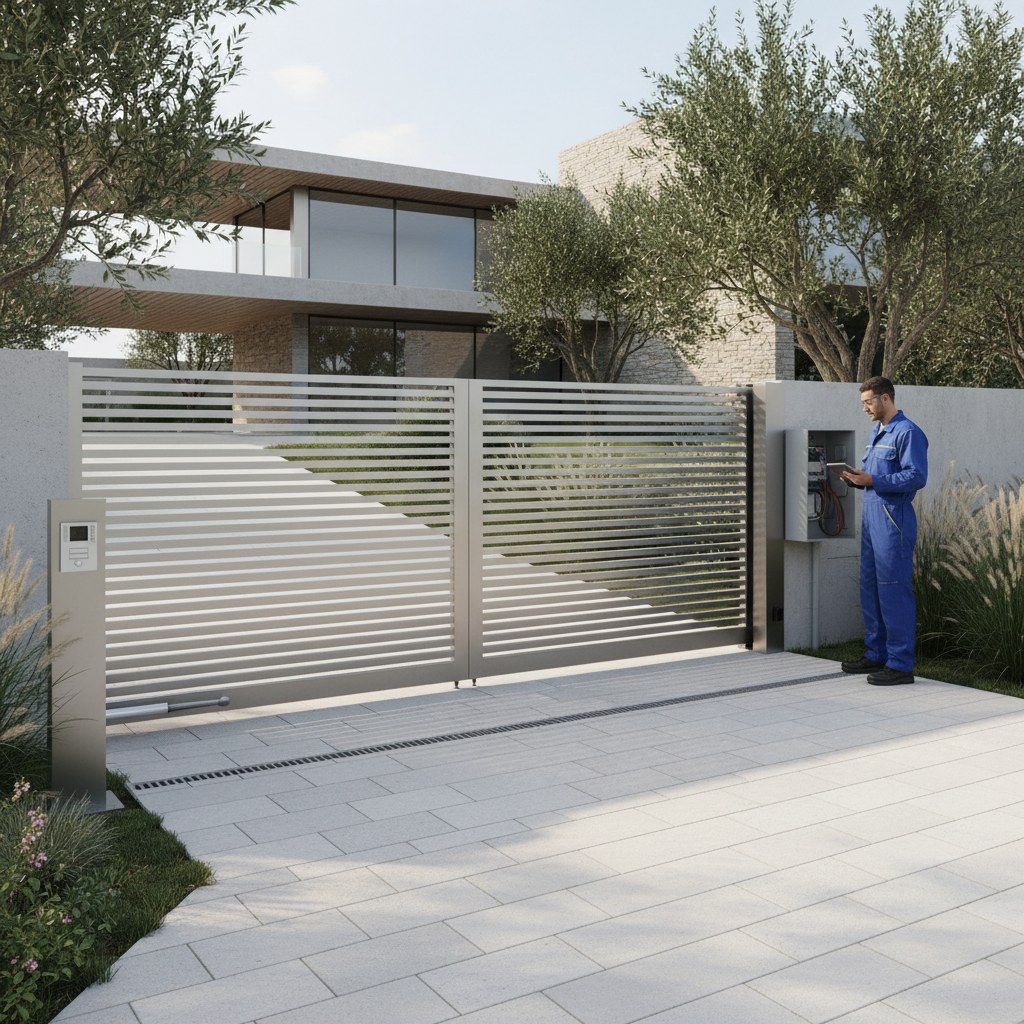


An automatic driveway gate is the ultimate blend of security, curb appeal, and modern convenience. When it works perfectly, you barely think about it. But the moment it fails—leaving your car trapped inside or your property wide open to the world—it quickly becomes a high-stress security risk.
Because automated entry systems rely on a complex mix of mechanical hardware, high-voltage electrical currents, and delicate digital sensors, a lot can go sideways. Many automated gate issues are simple maintenance oversights that you can address in a few minutes, while others stem from deeper component failures that require professional interventions to prevent irreversible motor burnout or electrical hazards.
If you are dealing with a completely broken system, exploring professional electric gate repair options is often the fastest way to restore safety. This comprehensive troubleshooting guide breaks down the 10 most common electric gate problems, explains why they happen, gives you actionable steps to fix them, and outlines exactly when it is time to cut power and call in a specialist.
The Core Components of an Automated Gate System
Before diving into troubleshooting, it is essential to understand how your system operates. An automatic gate is not just a piece of metal or wood attached to a motor; it is an ecosystem of interdependent technologies.
-
The Physical Gate & Hardware: The structural slab, track, hinges, rollers, and guide posts. If the physical structure is out of alignment, even the strongest motor will fail.
-
The Gate Opener/Operator: The mechanical powerhouse (hydraulic ram, articulated arm, or internal gear box) that physically moves the gate.
-
The Access Control System: The brains of the operation, including keypads, remote controls, intercoms, telephone entry panels, and smart vehicle identification loops.
-
The Safety Devices: Photoelectric safety beams (photo eyes), pneumatic or resistive safety edges, and loop detectors that detect obstacles to prevent vehicular damage or personal injury.
When troubleshooting, always analyze whether your issue is mechanical (jams, friction, physical wear) or electrical (power failures, sensor interruptions, signal interference).
1. The Gate Simply Won’t Open or Close (Total Power Loss)
The Symptoms
You press your remote control, enter your PIN on the wireless keypad, or pull up to your exit loop, and absolutely nothing happens. There are no motor noises, no clicking sounds from the control panel, and no flashing indicator lights.
The Root Cause
A total failure to move usually points to an interrupted electrical supply or a completely dead backup battery. Automated gates operate on localized high-voltage lines (typically $120\text{V}$ or $240\text{V}$ AC) stepped down via an internal transformer to run $12\text{V}$ or $24\text{V}$ DC circuits. If this primary line is cut or tripped, the system goes dark.
How to Diagnose and Fix It
-
Inspect the Main Breaker: Locate your home’s main electrical panel or the dedicated outdoor sub-panel for your gate. Check if the circuit breaker has tripped to the “Off” position. Reset it firmly.
-
Test the Dedicated Disconnect Switch: Code requirements dictate that an outdoor electrical disconnect switch must be located within sight of the gate operator. Ensure this switch has not been accidentally flipped off by a landscaper or utility worker.
-
Check GFCI Outlets: If your gate system plugs into or branches off an outdoor Ground Fault Circuit Interrupter (GFCI) outlet, check if the outlet has tripped due to moisture ingress. Press the “Reset” button.
-
Test the Battery Backup: Most modern gate operators feature an internal lead-acid battery backup system. If your primary power is on but the gate died after a storm, your battery may be completely exhausted, degraded, or holding a surface charge below the minimum voltage cutoff required to cycle the gate relays. Replace batteries every 2 to 3 years.
2. Obstructions along the Track or Travel Path
The Symptoms
The gate begins to open or close normally, travels a few feet, and then abruptly stops, reverses direction, or emits a continuous warning beep from the control board.
The Root Cause
Modern automatic gates are legally required to feature inherent intrinsic current-sensing safety mechanisms (mandated by safety standards like UL 325). When the motor control board detects a sudden spike in electrical current amperage, it interprets that resistance as striking a human, animal, or vehicle, and instantly reverses to prevent crushing.
How to Diagnose and Fix It
-
Clear the Track (Sliding Gates): Walk the entire length of your metal V-track. Even tiny gravel rocks, packed dirt, fallen tree branches, or dense leaf buildup will stall a sliding gate wheel and trigger the safety reverse. Use a stiff-bristle broom or a pressure washer to keep the track completely clear.
-
Examine the Swing Path (Swing Gates): Ensure that overgrown weeds, tall grass, decorative gravel piles, or shifting soil mounds are not physically scraping against the bottom edge of the gate frame during its travel arc.
-
Check for Winter Ice/Snow: In freezing climates, ice can easily pack into the track groove or freeze the rollers solid. Clear any hard ice accumulation and avoid using salt, which rapidly corrodes steel gate components.
3. Remote Control or Access System Failure
The Symptoms
The gate operates perfectly when you press the physical push-button inside your house or enter a code directly into the hardwired keypad, but it completely ignores your handheld remote controls, visor clips, or smartphone applications.
The Root Cause
This issue is isolated to the RF (Radio Frequency) receiver or the individual transmitting devices. It can stem from dead batteries, corrupted digital code hopping rolling codes, or localized ambient wireless interference.
How to Diagnose and Fix It
-
Swap Transmitter Batteries: This is the most common fix. If your remote’s LED light is dim or completely unlit when pressed, replace the coin-cell or A23 battery immediately.
-
Verify Line-of-Sight and Distance: If your remote only works when you are standing directly next to the metal control enclosure, your receiver antenna may be damaged, uncoiled, or blocked by heavy metallic screening.
-
Check for Radio Frequency Interference (RFI): Localized RFI from faulty wireless home security systems, military bases, ham radios, or even degrading smart LED bulbs in nearby outdoor light fixtures can swamp
-
Reprogram the Transmitters: Occasionally, severe power surges can wipe the volatile memory of your gate’s receiver card. Refer to your operator manual to put the control board into “Learn Mode” and re-pair your remotes. For complete system integration overhauls, exploring professional access control systems can resolve long-term wireless connectivity dead zones.
4. Misaligned or Blocked Photoelectric Safety Beams (Photo Eyes)
The Symptoms
The gate opens perfectly fine but refuses to close. When you command it to close, it might budge an inch and click back open, or you may notice a small red or amber light blinking continuously on one of the small plastic sensor enclosures mounted near the ground on your gate posts.
The Root Cause
To comply with modern safety standards, automated systems utilize non-contact photo eyes. These consist of an emitter sending an invisible infrared light beam across your driveway to a receiver. If that beam is broken, the gate’s logic board acts under the assumption that a car or child is standing in the path and prevents the gate from closing.
How to Diagnose and Fix It
-
Clean the Optical Lenses: Because photo eyes sit just 12 to 24 inches off the ground, they are constantly coated in mud splashes, lawn clippings, cobwebs, and road grime. Wipe down both lenses with a soft microfiber cloth and a mild glass cleaner.
-
Correct Physical Misalignment: Over time, ground settling, heavy winds, or a light bump from a lawnmower can bend the mounting brackets. Inspect the sensors visually. They must point directly at each other across the horizontal plane. Adjust the brackets until the indicator LED turns from blinking/red to solid green or amber.
-
Evict Insects and Pests: Small spiders and wasps love the warm, dry interior of photo eye enclosures. Unscrew the plastic covers to ensure bugs haven’t spun webs inside that block the internal optical components.
5. Corroded, Worn, or Squeaking Hinges and Rollers
The Symptoms
Your gate produces loud screeching, grinding, or groaning metallic noises while moving. The gate appears to travel sluggishly, moving noticeably slower than it used to, or it strains so hard that it causes your lights to dim slightly during operation.
The Root Cause
Mechanical friction is the number one killer of electric gate motors. If your sliding gate’s internal needle-bearing rollers are seized, or if your swing gate’s heavy-duty barrel hinges are completely dry and rusted, the motor has to exert massive amounts of mechanical torque to overcome that friction, drastically shortening its operational lifespan.
How to Diagnose and Fix It
-
The Manual Disengage Test: The fastest way to diagnose friction is to pull your operator’s manual release key or lever to put the gate into manual mode. Try pushing or swinging the gate by hand. It should move effortlessly with the force of just one or two fingers. If you have to strain your back to move it, your hardware is failing.
-
Apply Proper Lubrication: Never use standard WD-40 for long-term lubrication; it acts as a solvent and degreaser that quickly evaporates, leaving metal parts completely exposed to the elements while attracting airborne dust and grit. Instead, use a high-quality marine-grade grease for grease-zerk hinges, or a specialized heavy-duty silicone spray or white lithium grease for sliding gate tracks, guide rollers, and internal chain links.
-
Replace Flat-Spotted Rollers: If your sliding gate rollers have developed flat spots due to long periods of sitting or seizing, they must be replaced by a professional technician to prevent them from chewing up your ground track.
Comprehensive Component Comparison Matrix
To help you quickly identify what type of problem you are dealing with, use this structural reference chart:
| Problem Component | Primary Nature | Common Structural Cause | DIY Solution Level | Professional Solution Required |
| Circuit Breaker/GFCI | Electrical | Power surge, water ingress, short circuit | Reset breaker, dry out outlets | Rewiring, conduit replacement |
| Safety Photo Eyes | Electrical/Optical | Dirt, physical misalignment, spider webs | Clean lenses, realign brackets | Component replacement, wiring faults |
| Track & Gate Travel Path | Mechanical | Stones, mud, leaf buildup, overgrown roots | Sweep track, trim landscaping | Track welding, ground re-leveling |
| Hinges & Rollers | Mechanical | Lack of lubrication, rust, worn bearings | Apply silicone spray / white lithium | Bearing press, roller replacement |
| Drive Chain (Sliders) | Mechanical | Sagging chain, dry links, rust accumulation | Tension adjustment, apply chain lube | Chain link replacement, sprocket swap |
| Limit Switches | Electro-Mechanical | Magnetic shifting, corrosion, broken striker | Re-tighten set screws, wipe magnets | Internal board logic configuration |
| Backup Battery | Electrical | Natural chemical degradation, age ($>3$ years) | Swap drop-in battery cells | Charging circuit repair |
6. The Gate Opens or Closes Too Far (Limit Switch Failures)
The Symptoms
Your sliding gate doesn’t stop where it is supposed to; instead, it slams violently into the physical end-stop post or rolls completely off its ground track. Alternatively, your swing gate opens until it over-extends and binds up its own mechanical arm.
The Root Cause
Gate operators rely on internal components called limit switches to tell the motor control board exactly when the gate has reached its fully open and fully closed positions. These can be physical micro-switches struck by a metal cam, or modern magnetic proximity sensors that read a passing magnet attached to the gate chain or frame. If these components shift, break, or lose their magnetic properties, the motor runs blindly.
How to Diagnose and Fix It
-
Inspect the Limit Striker/Magnets: Look at your gate chain or the motor drive shaft. Ensure the physical metal tabs or small rectangular magnets have not slipped loose from their set screws. If they have moved, slide them back to their original positions and tighten them firmly.
-
Clean Magnetic Sensors: If your system uses magnetic limits, heavy snow, caked mud, or magnetic metallic dust buildup on the face of the sensor can block the magnetic field detection. Wipe the sensors down.
-
Calibrate Limits on Modern Digital Boards: Many newer residential operators utilize electronic smart limits programmed via LCD screens on the board. If your power went out or the board suffered a surge, you may need to enter the system programming menu to manually re-learn the open and close limits.
7. The Gate Opens on Its Own (Ghost Opening)
The Symptoms
You look out your window in the middle of the night or return home from work, only to find your automated gate standing wide open, leaving your property entirely insecure. You close it via your remote, and a few minutes or hours later, it mysteriously cycles back open all by itself.
The Root Cause
“Ghost openings” are incredibly frustrating but almost always point to loop detector glitches, stuck entry commands, or shorted command wires within your access terminal.
How to Diagnose and Fix It
-
Check for Stuck Keypad Buttons: Inspect your outdoor security keypad. If a button is worn out, degraded by UV rays, or jammed with dirt, it can permanently stick in the depressed position, sending a continuous opening signal to your gate operator.
-
Debris over Exit Loops: If you have an underground vehicle exit loop cut into your concrete driveway, it functions by detecting changes in electromagnetic inductance caused by heavy metals. If an old iron tool, a metal garbage can, or a wire-reinforced item is sitting directly on top of that loop path, it will trick the system into thinking a car is waiting to exit.
-
Examine Hardwired Loop Controls: Underground loop wires can degrade if the asphalt or concrete shifts and cracks. Water penetrating into the loop insulation creates a short-circuit to earth ground, triggering spontaneous opening commands. If this occurs, you will likely need professional diagnostics to isolate and replace the faulty underground loop wires.
8. Cold Weather Operational Sluggishness
The Symptoms
During warm summer months, your gate functions flawlessly. But as soon as winter temperatures drop below freezing, the gate moves at a crawl, stops halfway through its cycle, or refuses to budge while making a deep hum.
The Root Cause
Cold weather has a dramatic physical impact on both chemical batteries and mechanical lubricants. Standard grease thickens and becomes highly viscous when frozen, behaving like thick paste rather than a smooth lubricant. Additionally, cold temperatures slow down the chemical reactions inside lead-acid batteries, drastically dropping their peak cranking amperage when the motor needs it most.
How to Diagnose and Fix It
-
Switch to Low-Temperature Lubricants: If you live in an area prone to severe winters, completely clean out your old grease and apply a specialized synthetic low-temperature grease designed to maintain fluid viscosity down to sub-zero temperatures.
-
Install a Gate Operator Heater: Many professional brands offer internal, thermostatically controlled ceramic strip heaters that mount inside the operator chassis. These keep the gear box oil and electronics warm enough to prevent cold-stalling.
-
Upgrade Battery Capacity: Ensure your battery is fresh before winter hits. A battery that functions fine at $75^\circ\text{F}$ might completely collapse at $25^\circ\text{F}$.
9. Slipped, Slack, or Jumping Drive Chains
The Symptoms
This issue is specific to sliding gate styles. When the motor starts up, you hear it spinning internally, but the gate jerks erratically, makes a loud slapping sound, or the chain completely jumps off the motor’s drive sprocket gears, leaving the gate stationary.
The Root Cause
Sliding gates utilize a long piece of heavy-duty roller chain (usually #40 or #50 weight carbon steel) stretched across the length of the gate frame. Over months of use, the natural physical tension and weight cause the metal links to stretch. A loose chain will sag, whip violently during startup acceleration, and eventually slip off the drive gears.
How to Diagnose and Fix It
-
Check the Sag Ratio: As a general rule of thumb, a sliding gate chain should not sag more than approximately 1 inch for every 10 feet of total gate length. If it looks like a loose clothesline, it must be tensioned.
-
Adjust the Chain Take-Up Bolts: At either end of your gate frame, the chain is anchored by long threaded eye-bolts held by retaining nuts. Use an adjustable wrench to tighten these nuts evenly on both sides, pulling the chain taut until the excess center sag disappears.
-
Do Not Over-Tension: Be careful not to make the chain as tight as a guitar string. Over-tensioning puts destructive radial loads on the internal shaft bearings of your gate motor, leading to catastrophic oil seal blowouts and gear failures.
10. Strange Internal Noises and Motor Burnout
The Symptoms
The motor runs, but you hear a distinct whirring, spinning, or high-pitched grinding sound from inside the operator chassis, yet the gate does not move at all. Alternatively, you smell a strong, acrid burning plastic or electrical odor coming from the ventilation slots of the motor housing.
The Root Cause
This is typically indicative of an internal mechanical disconnection or a complete electrical winding failure within the motor itself. Most gate operators utilize an internal sacrificial nylon or brass blend drive gear connected to a steel worm gear. If the gate hits a solid wall or is forced open by a vehicle, this internal gear is engineered to strip out completely to protect the primary electric motor shaft from snapping.
How to Diagnose and Fix It
-
Check the Internal Drive Gears: Turn off the main circuit breaker. Remove the external plastic or metal hood of your gate operator housing. Look closely at the drive gears. If you see piles of shredded yellow or white plastic shavings inside the chassis base, your internal drive gear is stripped.
-
Inspect the Start Capacitor: On alternating current (AC) gate motors, a large cylindrical component called a start capacitor provides the massive phase-shifted electrical boost needed to get the motor spinning. If the capacitor bulges, cracks, or leaks oil, the motor will simply sit still, emit a loud hum, and quickly overheat without turning.
-
Do Not Attempt DIY Internal Motor Repairs: Working inside the high-voltage section of a gate operator or attempting to rebuild a pressurized internal hydraulic pump chamber is highly dangerous. If your internal gears are destroyed or your motor windings have shorted out, it is time to contact an authorized service center.
When to Call a Certified Gate Specialist
While clearing a pebble out of a sliding track or wiping dirt off a photo eye lens is well within the realm of weekend DIY maintenance, automated gates can pose genuine safety hazards if handled incorrectly. You should skip the DIY approach and immediately contact a licensed professional if you encounter any of the following scenarios:
-
High-Voltage Electrical Failures: If you trace your issue to a short circuit inside the main $120\text{V}/240\text{V}$ incoming power terminal, or if your property’s main breaker continuously trips every single time the gate tries to cycle. Improperly grounded electrical connections in damp outdoor environments can lead to lethal electrical shocks.
-
Structural Gate Sagging or Welding Failures: If your heavy wrought-iron or steel gate is sagging because a structural support post has warped, or if a structural hinge weld has cracked, do not attempt to prop it up. If a multi-hundred-pound metal gate falls off its mounts, it can cause severe crush injuries or major property damage.
-
Complete Motor Operator Replacements: If your system has been struck by lightning, suffered a major flood, or the motor has completely burned out due to old age, installing a fresh unit requires precise technical calibration to align with current safety laws.
If you are currently facing a complex system failure, an unreliable gate opener, or require structural welding repairs, booking an expert electric gate repair service ensures your perimeter security is restored safely using code-compliant diagnostics.
Proactive Preventative Maintenance Checklist
To extend the lifespan of your automated entry system and completely avoid unexpected lockouts, execute this quick maintenance routine every six months:
-
[ ] Visual Track Inspection: Check for cracks in concrete slabs, loose track anchors, or rust spots.
-
[ ] Manual Friction Test: Release the gate clutch and confirm it glides smoothly by hand.
-
[ ] Hardware Lubrication: Apply high-quality silicone spray to all guide rollers, chains, and hinges.
-
[ ] Safety Sensor Test: Wave an object in front of the photo eyes while the gate is closing to ensure it instantly halts and reverses.
-
[ ] Enclosure Pest Control: Open the motor housing and clean out any spider webs, wasp nests, or rodent debris that could short out sensitive digital circuit paths.
If your existing entry layout is continually breaking down due to outdated hardware, or if you are looking to modify your residential perimeter entirely, learning more about the process can help. Check out our foundational breakdown on electric gate installation to see how modern engineering fixes structural weaknesses before they begin.
Frequently Asked Questions (FAQ)
How long should a residential electric gate motor typically last?
With proper routine maintenance, clear tracks, and regular lubrication, a high-quality residential gate operator lasts between 8 to 15 years. Lifespans are heavily dictated by daily duty cycles (how many times the gate opens and closes per day) and regional environmental factors like high humidity, salt air, or freezing winter conditions.
Can I manually open my automated gate if my home suffers a power outage?
Yes. Every code-compliant electric gate operator is legally required to feature a mechanical manual release mechanism. This is typically a physical key, a specialized hex wrench tool, or a mechanical foot pedal lever located at the base of the motor housing that mechanically disengages the internal drive gears, allowing you to easily push or swing the gate open by hand.
Why does my gate operator beep continuously when I try to activate it?
Continuous or patterned beeping from your gate operator is a diagnostic error code emitted by the internal logic control board. This usually signals that the system has entered a Hard Lockout Mode because it triggered its safety edge or inherent current-sensing obstruction limits twice consecutively. Check for physical obstructions along the track or path, clear any blockages, and reset the system by toggling the main power switch off and on.
Is it safe to use standard WD-40 to lubricate my gate tracks and chain?
No. Standard WD-40 is a water-displacement spray and solvent, not a long-lasting mechanical lubricant. While it may temporarily quiet a squeak, it breaks down existing grease, evaporates within days, and leaves a sticky residue that actively attracts dirt, abrasive sand, and silica dust. This creates a grinding paste that rapidly wears out your rollers and chain links. Always use a dedicated white lithium grease, marine grease, or high-performance dry silicone spray lubricant.
Why does my gate move incredibly slowly during the winter time?
Cold winter temperatures cause standard mechanical greases and gear oils to thicken significantly, increasing internal mechanical resistance. Simultaneously, cold weather reduces the operational efficiency and peak voltage output of internal backup batteries. The combination of increased friction and reduced electrical power output causes the control board to restrict speed or stall entirely. Switching to synthetic low-temperature lubricants can resolve this environmental issue.
Need Expert Assistance with Your Automatic Gate?
If you are tired of dealing with an unreliable gate, mysterious ghost openings, or a noisy motor, don’t leave your property’s perimeter security to chance. Discover who we are and our commitment to excellence on our about us page.
The certified team at BMS Electric Gates provides expert diagnostics, routine maintenance packages, and code-compliant installations tailored to your property’s specific needs.
-
Learn more about our core capabilities on our general services overview page.
-
Explore our specialized automatic gate opener services to upgrade your system to a modern, smart-home compatible motor.
-
Check if our mobile repair technicians serve your neighborhood by browsing our active service areas.
-
Ready to schedule an onsite diagnostic consultation? Contact us directly today to speak with an experienced specialist.